AI News: 5 Powerful New AI Models Launched This Week
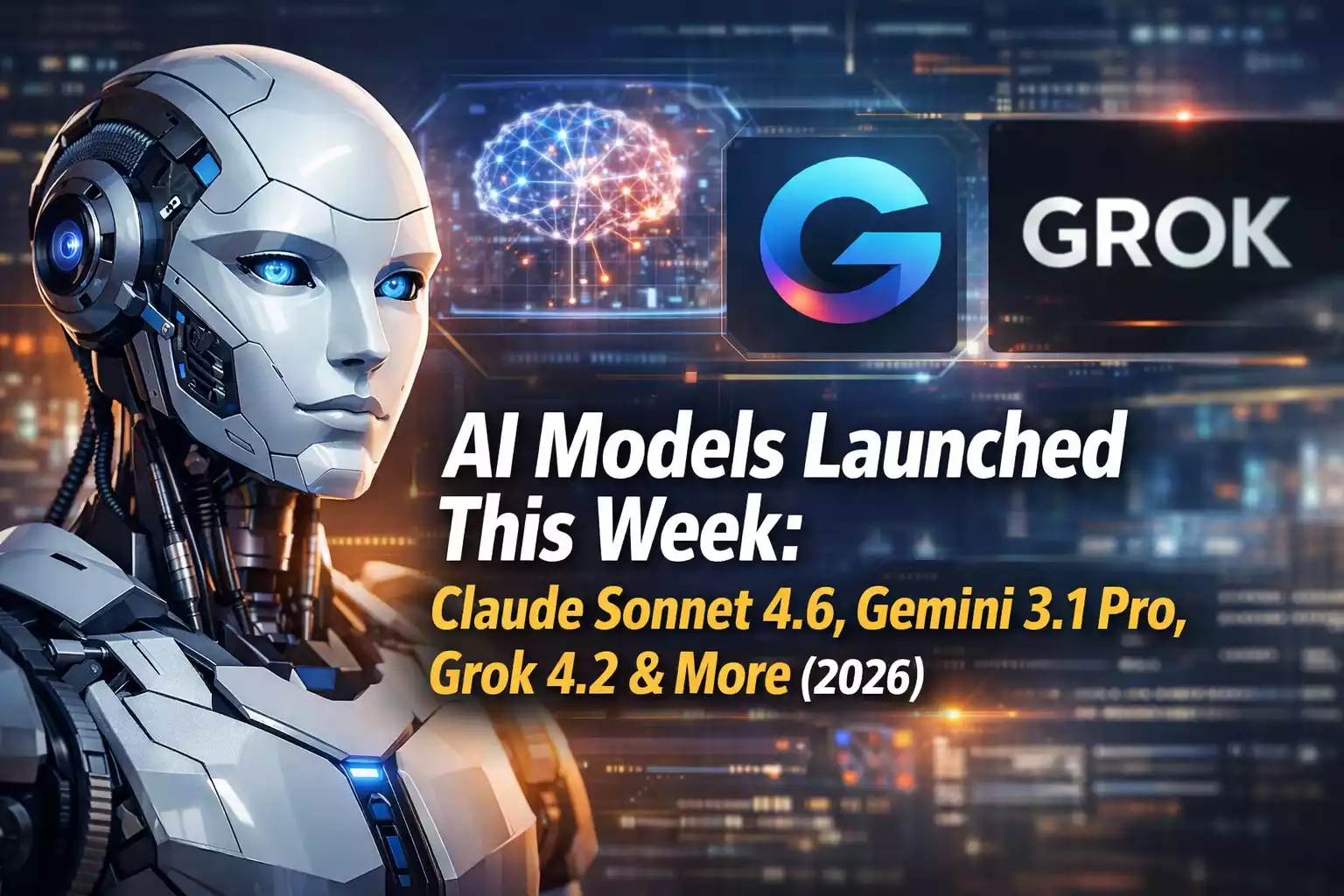
The AI industry never slows down — and this week was proof of that. Five major model releases dropped across Anthropic, Google, xAI, ByteDance, and Alibaba, along with several standout feature updates that are already changing how developers and creators work. Whether you’re building apps, making content, or just staying informed, here’s everything you need to know about this week’s biggest AI launches.
1. Claude Sonnet 4.6 — Anthropic’s Most Capable Default Model Yet
Anthropic officially made Claude Sonnet 4.6 the default model for most Claude users, and it’s not hard to see why. Without reaching all the way to the premium Opus tier, this model delivers performance that comes impressively close — especially in the areas that matter most for real-world work: agentic coding, computer use, and tool calling.
The headline feature for developers is a 1 million token context window accessible via the API. In practice, this means you can feed Claude an entire large codebase, a full research paper library, or a lengthy legal document and still get coherent, contextually aware responses. For everyday users, the day-to-day feel is smoother and more reliable. For power users and developers, it’s a genuine capability leap.
Anthropic also tuned Claude’s web search behavior significantly. Instead of pulling in every vaguely related source, the model now filters for genuinely relevant results — which keeps responses tighter, reduces token waste, and makes answers more useful. On top of that, new PowerPoint integrations let users generate entire slide decks and native charts from simple text descriptions, which is a big win for anyone who regularly builds presentations.
AI से पैसे कमाने के 50 तरीके 2026 – पूरी जानकारी हिंदी में
2. Claude Code to Figma — Closing the Gap Between Design and Development
One of the more quietly impressive announcements from Anthropic this week was the Claude Code to Figma workflow. This integration solves a problem that almost every product team deals with: the painful back-and-forth between designers and developers.
Here’s how it works. Claude connects to your local development server, captures a specific page from your live project, and exports it directly into Figma as an editable frame. Designers can then take over — adjusting layouts, colors, fonts, and components entirely within Figma, without needing to touch the codebase. When they’re done, a Figma MCP server sends those design changes back, and Claude translates them into real front-end code.
The result is a faster, more collaborative workflow where neither side has to wait on the other. For web teams building apps or marketing sites, this kind of tight feedback loop can meaningfully cut down project timelines.
3. Google Gemini 3.1 Pro — Strong Reasoning, SVG Animation, and Wide Rollout
Google’s Gemini 3.1 Pro landed this week as an upgraded version of Gemini 3 Pro, and it’s available across Google AI Studio, Gemini CLI, Android Studio, Vertex AI, and the consumer Gemini experience. On benchmarks involving abstract reasoning, science, terminal tasks, and agentic tool use, it holds its own against the best closed models available right now.

In coding and research-heavy workflows, the model performs competitively with alternatives from Anthropic and OpenAI. But the feature generating the most buzz is its ability to generate complex animated SVGs directly from text prompts. Ask it for a “wolf playing basketball” or a stylized character animation, and it produces motion graphics that would otherwise require hours of manual SVG coding.
For front-end developers, UI engineers, and creative coders, this is a meaningful new tool. The easiest place to explore it is Google AI Studio, where you can test prompts and immediately see the SVG output rendered in place.
4. Lyria 3, Pomelli, and NotebookLM — Google’s Creator-Focused Releases
Beyond the core language model update, Google shipped several smaller but genuinely useful tools for creators and marketers this week.
Lyria 3 — AI Music in Seconds
Google’s new Lyria 3 music generation model is now accessible through the Gemini app, producing roughly 30-second music clips from natural language descriptions. Want a lo-fi hip-hop intro for your YouTube video, or an upbeat jingle for a product reel? Describe the genre, mood, and energy, and Lyria 3 handles the rest. It’s not a full music production suite, but for quick content clips and social media snippets, it fills a real gap.
Pomelli — On-Brand Product Photos Without a Photoshoot
Pomelli is aimed squarely at marketers and e-commerce businesses. It analyzes your brand’s existing website and visual assets — picking up your color palette, typography, and visual style — and then transforms basic product photos into polished, campaign-ready images across templates like studio, lifestyle, and ingredients shots.
For small teams operating without a dedicated design department, Pomelli can dramatically cut both cost and turnaround time for visual content.
NotebookLM — Edit Slide Decks With Plain English
NotebookLM received a small but appreciated update: you can now revise slide decks using natural language commands. Prompts like “make the background a grid pattern” or “simplify the layout” trigger a full regeneration of the deck’s visual style. Researchers, teachers, and content creators who iterate frequently on presentations will find this genuinely useful.
5. Grok 4.2, ByteDance Seed 2.0, and Alibaba Qwen 3.5 — Global AI Competition Intensifies
The second half of this week’s AI news came from outside the usual US tech giants, with xAI, ByteDance, and Alibaba all making significant moves.
Grok 4.2 Beta — A Council of AI Agents
xAI’s Grok 4.2 takes an interesting structural approach: instead of a single model answering your query, it deploys four distinct AI personas — Grok, Harper, Benjamin, and Lucas — each optimized for a different strength, like research, logic, creativity, or factual knowledge. They collaborate internally and surface a single, synthesized response.
This “council” architecture points toward a broader shift in how complex AI systems might be designed — using specialized agents rather than one generalist model. Whether this improves real-world performance consistently is still being tested, but as a design pattern it’s worth watching.

ByteDance Seed 2.0 — Multimodal Performance With Caveats
ByteDance released Seed 2.0 in three variants — Pro, Lite, and Mini — with a focus on multimodal and vision-heavy tasks. The models reportedly excel at math-vision and motion perception benchmarks, outperforming several Western models on those specific tasks.
That said, reviewers have flagged that heavy benchmark optimization can sometimes inflate scores without delivering the same gains in everyday use. Real-world evaluation is still ongoing, but the numbers alone signal how seriously ByteDance is investing in frontier AI research.
Alibaba Qwen 3.5 — Open-Weight Model Closing the Gap
Perhaps the most consequential release of the week for the open-source AI community is Alibaba’s Qwen 3.5 397B-A17B. It’s a large, natively multimodal, openly available model — and on many benchmarks it comes surprisingly close to closed systems like Claude Opus, leading GPT-class models, and Gemini 3 Pro.
The broader trend this represents is hard to ignore: open-weight models are consistently narrowing the gap with proprietary ones, generation after generation. For developers, this means more flexibility, greater control over deployment, and lower infrastructure costs — without giving up much in terms of raw capability.
Beyond the Models — Policy Debates and Futuristic Experiments
This week’s AI news wasn’t limited to model releases. Several policy debates and ethically complex applications also made headlines.
In the US, reports surfaced that the Pentagon is exploring advanced AI for sensitive applications including surveillance and autonomous systems. Anthropic and similar companies have pushed back with strict usage policies, creating ongoing tension between national security demands and responsible AI deployment.
ByteDance’s hyper-realistic video generation technology drew sharp criticism from Hollywood studios, SAG-AFTRA, and the MPA, who raised concerns about likeness misuse and intellectual property. ByteDance has committed to stronger safeguards, though regulators haven’t caught up yet.
Meta drew attention for a patent describing AI systems capable of simulating a deceased user’s online presence — continuing to post and message based on their historical data. Meanwhile, companies like Tavus are advancing highly realistic talking avatar technology, and robotics firm Unitree showcased humanoid robots performing synchronized martial arts routines on stage.
All of this points to the same conclusion: AI’s capabilities are advancing faster than the frameworks we have to govern them.
FAQ
What is Claude Sonnet 4.6? Claude Sonnet 4.6 is Anthropic’s latest default AI model, offering near-Opus performance for coding, reasoning, and agentic tasks — with a 1 million token context window available via API.

Is Gemini 3.1 Pro better for developers? Gemini 3.1 Pro performs strongly in coding, scientific reasoning, and tool-use tasks. Its ability to generate animated SVGs from text prompts makes it especially useful for front-end developers and creative coders.
What is Qwen 3.5 and why does it matter? Qwen 3.5 is Alibaba’s open-weight model that competes with leading closed-source AI systems. Its open availability gives developers more deployment flexibility at lower cost, continuing the trend of open models closing the gap with proprietary alternatives.
What is Grok 4.2’s multi-agent council? Grok 4.2 uses four AI personas — Grok, Harper, Benjamin, and Lucas — each specialized for different reasoning styles. They work together to produce a final, synthesized answer, representing a new approach to AI system design.
Is Lyria 3 free to use? Lyria 3 is accessible through the Gemini app. Availability may depend on your Gemini subscription tier — check the Google Gemini app for current access details.
🤖 AI में 2026 के बड़े बदलाव — जो आपको जानने चाहिए!
(देश और दुनिया की ताज़ा खबरें सबसे पहले पढ़ें Deshtak.com पर , आप हमें Facebook, Twitter, Instagram , LinkedIn और Youtube पर फ़ॉलो करे)