Google Bans OpenClaw Users on Antigravity — Here’s What Actually Happened
If you woke up over the weekend to find your Antigravity access suddenly gone, you’re not alone — and you’re probably not even sure what you did wrong.
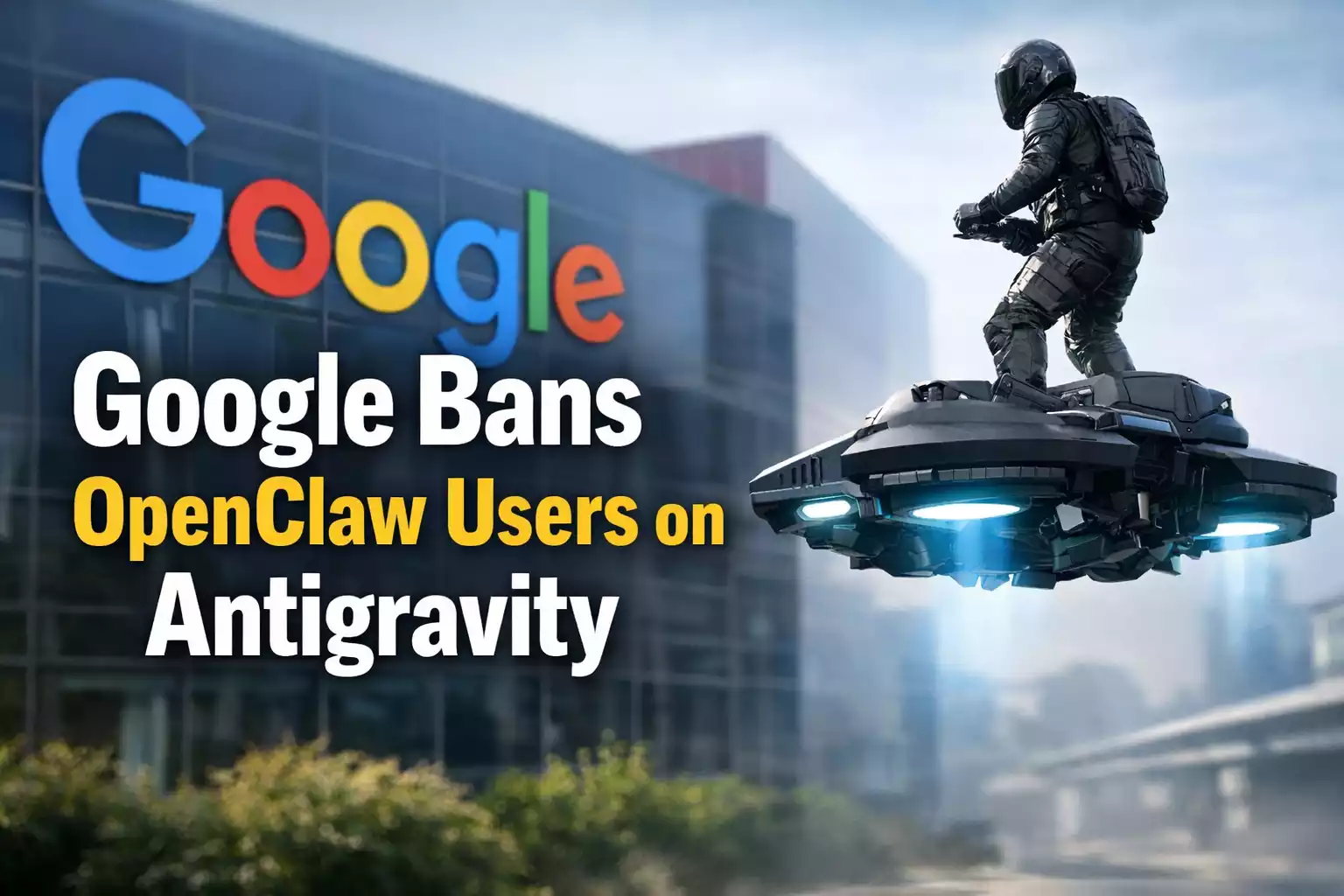
Google has restricted access to Antigravity, its AI coding platform, for users who were routing Gemini tokens through OpenClaw, the open-source AI agent framework. The company cited “malicious usage” that was degrading the service for paying customers. The Google bans OpenClaw users situation escalated fast, caught developers off guard, and is part of a much bigger shift happening across the AI industry right now.
Here’s everything that happened, why it matters, and what you should do if you got caught in it.
What Is Antigravity and Why Does It Matter?
Antigravity is Google’s AI-powered coding platform — think of it as Google’s answer to tools like Cursor or GitHub Copilot, but built directly on top of Gemini, Google DeepMind’s flagship model family.
It’s designed for developers who want AI assistance baked into their coding workflow: autocomplete, code generation, debugging suggestions, that kind of thing. And because it runs on Gemini under the hood, it gives users access to one of the most capable models in the world right now.
The key thing to understand is that Antigravity is a subscription product. You pay, you get access to a defined amount of compute. Google builds pricing around expected usage patterns — a normal developer writing code, asking questions, iterating on functions.
What it’s not built for is serving as a backend relay for an entire fleet of AI agents running at scale. Which is exactly what started happening.
What Is OpenClaw and What Was It Doing?
OpenClaw is an open-source AI agent framework. It lets developers build AI-powered workflows and pipelines by connecting to various AI models through a common interface. On its own, that’s a perfectly legitimate tool — and it’s genuinely useful.
The problem is in how some users were connecting it to Antigravity.
Instead of using OpenClaw with a dedicated API key or a model provider that explicitly supports third-party access, some developers were using it to route requests through their Antigravity subscriptions. Essentially, they were using a personal subscription — priced for individual developer use — as a backend for automated, high-volume AI workloads.
That’s where the ToS violation comes in. Google’s terms of service for Antigravity prohibit using the platform as a proxy or relay for third-party tools, especially when that usage goes well beyond what a normal subscription is designed to support.
To put it plainly: it’s like buying a single movie ticket and then setting up a projector in the parking lot for a hundred people. You’re not technically pirating the movie — but you’re definitely not using the ticket the way it was sold.
OpenClaw’s token routing pushed Antigravity’s servers to a point where it was affecting the experience for everyone else on the platform. That’s when Google stepped in.
What Google Says Happened
Varun Mohan, a Google DeepMind engineer and former Windsurf CEO, confirmed the action in a post on X over the weekend. He said the company had seen a “massive increase” in users exploiting the Antigravity backend as a proxy for third-party platforms — overwhelming compute resources that were supposed to be available for paying subscribers.
“We understand that a subset of these users were not aware that this was against our ToS and will get a path for them to come back on but we have limited capacity and want to be fair to our actual users,” Mohan wrote.

A Google DeepMind spokesperson later confirmed to VentureBeat that this is not a permanent ban. The goal, they said, is to bring usage back in line with the platform’s terms — not to permanently lock out everyone who connected OpenClaw to Antigravity.
That’s a meaningful distinction. It suggests Google is doing some degree of triage — distinguishing between developers who genuinely didn’t realize this was a violation and those who were clearly running high-volume, automated workloads at scale.
The crackdown happened without warning. Users on X and Y Combinator forums reported losing access with zero prior notice. Some expressed concern that the ban could affect their broader Google accounts — a legitimate worry, given that Antigravity shares the same account infrastructure as Gmail, Google Workspace, and other Google products. Google hasn’t confirmed whether any account-level actions were taken beyond Antigravity access.
If you got banned and you genuinely didn’t realize this was against the rules, don’t panic. Mohan’s statement specifically acknowledges that some users weren’t aware. A reinstatement path is reportedly coming.
Anthropic Did the Same Thing Two Days Earlier
Google isn’t working from an original playbook here. Just two days before the Antigravity crackdown, Anthropic updated its own terms of service to explicitly prohibit OAuth token usage from Claude subscriptions in third-party tools — and yes, that explicitly includes OpenClaw.
The timing is hard to ignore. Two of the biggest AI providers in the world updated their ToS and enforcement in the same week to address the same behavior. This isn’t a coincidence — it’s a coordinated signal from the industry that AI providers are actively moving to close the gaps between what their products are sold as and how they’re actually being used.
Anthropic’s move was slightly different in nature — it was a ToS update rather than an active ban — but the direction is identical. If you’re using a Claude subscription to power a third-party agent at scale, that’s now explicitly against the rules.
For developers who’ve been building workflows that rely on this kind of access, this is a real problem. And it’s one that’s not going away.
What This Means for Developers
If you’re a developer who got hit by this — or who’s now looking at your own setup nervously — here’s a practical breakdown of where things stand.
If you were using OpenClaw with your personal Antigravity subscription: You may have lost access already. The path back reportedly exists but hasn’t been fully detailed yet. Watch Mohan’s posts on X and Antigravity’s official channels for updates.
If you’re building agent workflows that need high-volume model access: Personal subscriptions are not the right tool. They were never the right tool — this just wasn’t enforced until now. You need to be using official API access, which is priced and rate-limited in a way that actually accounts for the compute you’re using.
If you weren’t doing this but use OpenClaw for other things: You’re probably fine. The issue is specifically about routing Antigravity/Gemini tokens through OpenClaw as a backend proxy. Using OpenClaw with your own API keys for models that support third-party access is a different situation entirely.
If you’re serious about building with frontier models at scale, get an API key and budget accordingly. It costs more upfront, but it doesn’t come with the risk of losing access to your entire Google account ecosystem.
Can Banned Users Get Their Access Back?
Yes, apparently — but the timeline is unclear.
Mohan confirmed that Google is working on a reinstatement path for users who were affected. His language was careful: he distinguished between users who genuinely didn’t know this violated the ToS and those who were clearly running exploitative workloads.
What that process looks like in practice hasn’t been spelled out yet. There’s no public form, no official page, no support ticket category specifically for this as of the time of writing. The most likely path is through Antigravity’s standard support channels, possibly with some kind of acknowledgment that you’ve read and will comply with the ToS going forward.

The concern that’s worth taking seriously: if your Google account was flagged rather than just your Antigravity access, that’s a more serious situation. Google accounts are load-bearing infrastructure for a lot of people — Gmail, Drive, Workspace, YouTube. Losing access to that ecosystem is a very different problem than losing access to one coding tool.


If you’re in that situation, contact Google account support directly in addition to any Antigravity-specific channels.
The Bigger Picture: AI Providers Are Closing the Gaps {#bigger-picture}
Zoom out for a second, because what’s happening here is bigger than one weekend ban.
For the past couple of years, AI subscriptions have been a kind of open secret arbitrage opportunity. You pay $20 or $30 a month for a consumer subscription, and if you know what you’re doing, you can route that through an open-source framework to power workloads that would cost hundreds or thousands of dollars per month via official API access.
Providers knew this was happening. They just weren’t enforcing against it aggressively — probably because they were more focused on growth than on cost management.
That’s changing. As AI infrastructure costs have become clearer, and as usage patterns have shown just how much compute some of these proxy setups consume, the major providers are drawing harder lines.
What we saw this week — Google banning OpenClaw users from Antigravity, Anthropic updating its ToS to cover the same behavior — is the beginning of what will probably be a broader tightening. If you’re relying on subscription-level access to power anything beyond personal developer use, assume that access will get harder, not easier.
The tools that were built around this gap — frameworks like OpenClaw that made it easy to route subscriptions to high-volume agent workflows — will need to adapt. Some will pivot to official API integrations. Some will look for providers that explicitly allow this kind of use. And some users will simply have to accept that the free lunch is over.
Before your current setup gets flagged, audit which of your workflows are running through subscription-based accounts versus proper API keys. Make the switch proactively. It’s a much less stressful conversation to have on your own terms.
FAQ
Why did Google ban OpenClaw users on Antigravity?
Google restricted access to Antigravity for users who were routing Gemini tokens through OpenClaw, an open-source AI agent framework. The issue wasn’t OpenClaw itself — it was how users were connecting it to Antigravity. They were using personal subscriptions as a backend proxy for high-volume automated workloads, which overwhelmed Antigravity’s compute resources and degraded the experience for paying subscribers. Google cited this as a violation of its terms of service.
Is the Google Antigravity ban permanent?
No, according to Google DeepMind. A spokesperson confirmed to VentureBeat that the action is not a permanent ban but an effort to bring usage into compliance with the platform’s ToS. Varun Mohan, a Google DeepMind engineer, also stated that a path to reinstatement is being worked on for users who were unaware their usage violated the rules.
What is OpenClaw and why was it being used with Antigravity?
OpenClaw is an open-source AI agent framework that lets developers build automated workflows by connecting to AI models through a common interface. Some developers were using it to route their Antigravity subscription’s Gemini tokens through OpenClaw — effectively using a personal subscription as infrastructure for larger-scale workloads. This is what triggered the ban.
Did the OpenClaw ban affect Google accounts beyond Antigravity?

Some users on X and Y Combinator forums raised concerns that their broader Google accounts might be affected, since Antigravity shares account infrastructure with Gmail and Workspace. Google hasn’t officially confirmed any account-level actions beyond Antigravity access, but if you’re concerned, it’s worth contacting Google account support directly.
What did Anthropic do around the same time?
Two days before Google’s crackdown, Anthropic updated its terms of service to explicitly ban OAuth token usage from Claude subscriptions in third-party tools, including OpenClaw. The back-to-back moves from two major AI providers in the same week signal a broader industry shift toward stricter enforcement of how subscriptions can be used outside first-party interfaces.
What should developers do if they relied on OpenClaw routing for their workflows?
The short-term answer is to switch to official API access for the models you need. API access is priced to account for actual compute consumption, which means it costs more at scale — but it also means you’re not at risk of losing access suddenly. Review your current workflows, identify anything running through subscription-based accounts, and migrate those to proper API integrations before they get flagged.
How can affected users get their Antigravity access restored?
Varun Mohan confirmed that a reinstatement path is coming for users who genuinely didn’t realize they were violating the ToS. As of now, there’s no dedicated process or form publicly available. The safest approach is to reach out through Antigravity’s official support channels and be upfront about your situation. The company’s own statements suggest it’s distinguishing between unknowing violators and deliberate bad actors.
conclusion
The Google bans OpenClaw users story is a lot more than a weekend platform dispute. It’s a sign of where the AI industry is heading.
Subscriptions were always a consumer product. They were priced for a person writing code, having conversations, iterating on ideas. The moment developers started treating them as infrastructure for automated, high-volume agent workflows, it was only a matter of time before providers pushed back.
That time is now.
If you’re building anything serious with frontier AI models, the lesson is simple: use the right tool for the job. That means official API access, proper rate limit planning, and a setup that doesn’t depend on exploiting pricing gaps that were always going to get closed eventually.
For developers who got caught in this — especially those who genuinely didn’t realize they were breaking the rules — there’s a path back. Stay close to Antigravity’s official channels and Varun Mohan’s updates on X for reinstatement details as they come.
And if you’re looking at your own setup right now wondering if you’re next, do the audit before someone else does it for you.
🤖 AI में 2026 के बड़े बदलाव — जो आपको जानने चाहिए!
(देश और दुनिया की ताज़ा खबरें सबसे पहले पढ़ें Deshtak.com पर , आप हमें Facebook, Twitter, Instagram , LinkedIn और Youtube पर फ़ॉलो करे)